
In the world of natural skincare, few ingredients have stood the test of time like Aloe Vera. Often dubbed the “Plant of Immortality” by ancient Egyptians, it is far more than just a sticky green gel you apply to a sunburn in July. When formulated correctly into a shower gel, Aloe Vera becomes a powerhouse of daily hygiene, a “Queen of Plants” capable of transforming your shower routine.
The problem with the modern body wash market is polarization. You often have to choose between “clinical” products that smell like medicine but work, or “natural” products that smell great but leave your skin feeling tight and dry. This is where Aloe bridges the gap. It offers a deep, enzymatic cleanse that purifies the skin without stripping its essential moisture barrier.
While selecting the right hero ingredient is crucial, it is just one piece of the puzzle in building a perfect skincare regimen. To understand how ingredient sourcing fits into the bigger picture of body care, check out our Ultimate Guide to Choosing the Best Shower Gel.
However, if you are looking for a cleanser that balances nature with efficacy, this guide is for you. In this article, we will explore the science behind why Aloe is superior to water-based cleansers and review the top Aloe-infused picks for 2025.
The Science of Aloe: More Than Just Water
To understand why Aloe works, we have to look at its biological makeup. When you see Aloe Barbadensis Leaf Juice on a label, you are looking at a complex biological entity.
The Composition
While the Aloe plant is approximately 99% water, the magic lies in the remaining 1%. That small fraction contains over 75 active compounds, including:
- Vitamins: A (beta-carotene), C, and E, which are antioxidants.
- Enzymes: Such as alkaline phosphatase and bradykinase, which help reduce inflammation.
- Minerals: Calcium, chromium, copper, selenium, magnesium, manganese, potassium, sodium, and zinc.
- Salicylic Acid: A naturally occurring beta-hydroxy acid (BHA) that exfoliates and fights bacteria.
The Delivery Mechanism
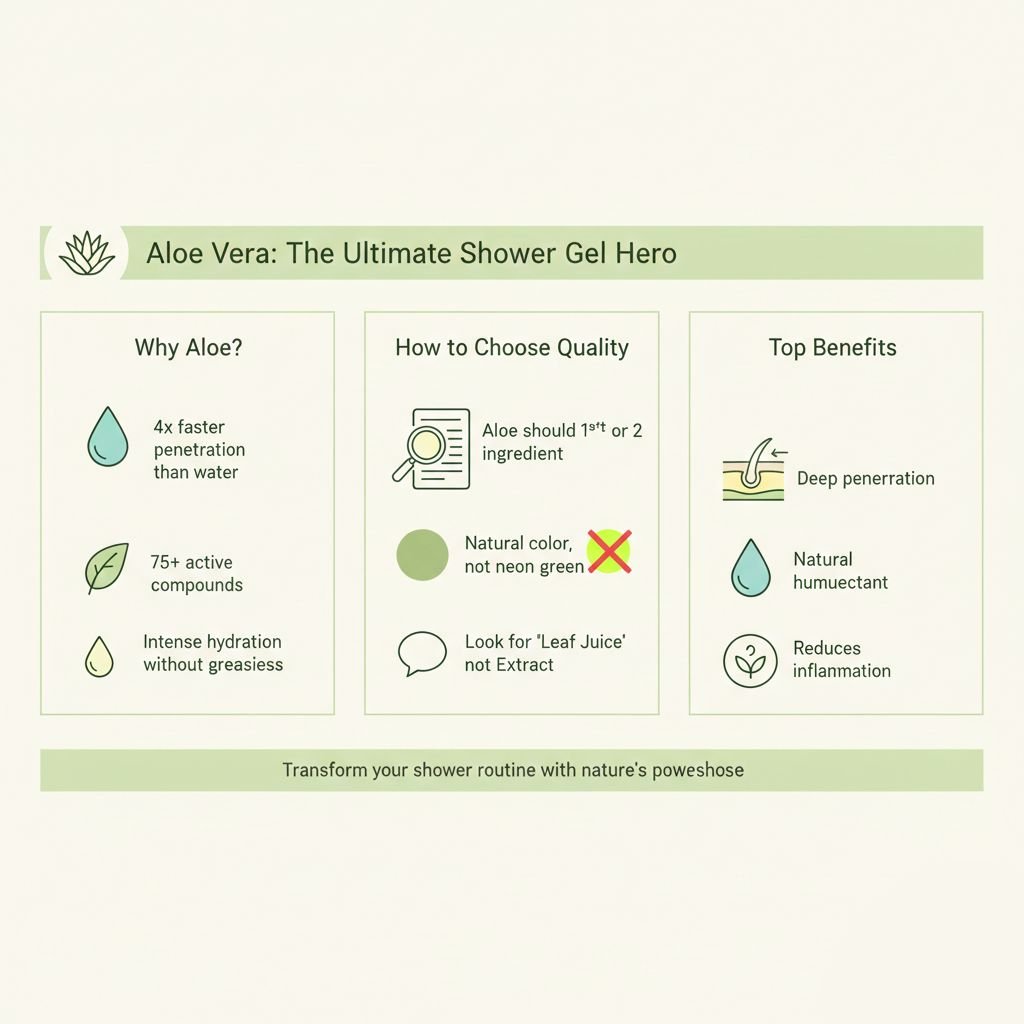
Water sits on top of the skin. Aloe, however, contains lignin, an inert substance that enhances the penetrative effect of the other ingredients. Studies suggest that Aloe Vera can penetrate the epidermis (the outer layer of skin) up to four times faster than water. This makes it an incredible “carrier,” pulling hydration and nutrients deep into the skin rather than just washing them down the drain.
Top Benefits of Using Aloe-Based Shower Gels
Switching to an Aloe-first body wash isn’t just a trend; it’s a strategic move for skin health. Here is why it matters, supported by the science of skincare.
1. Intense Hydration Without Greasiness
There is a distinct difference between moisturizing (adding oil) and hydrating (adding water). Many creamy body washes rely on heavy oils that can leave a film on the skin, which some users find uncomfortable in humid weather or if they have oily skin.
Aloe Vera acts as a humectant, drawing moisture from the air and binding it to the skin without clogging pores. It hydrates the skin matrix directly.
However, skin needs are personal. If your skin is extremely parched and requires heavier, oil-based occlusion alongside hydration, you might prefer the options listed in our guide to the 10 Best Moisturizing Shower Gels for Dry Skin in 2025.
2. A Natural Alternative to Harsh Surfactants
One of the most fascinating properties of Aloe is its content of saponins. These are soapy substances that form about 3% of the gel. Saponins have natural cleansing and antiseptic properties, meaning an Aloe-based gel can clean your body effectively with much lower concentrations of chemical detergents.
This is why high-quality Aloe gels rarely need harsh sulfates (SLS) to generate lather. Because Aloe is so gentle, it is frequently paired with mild, plant-derived cleansers. Learn more about the importance of avoiding harsh chemicals in our article on Sulfate-Free Shower Gels: Top Benefits and 8 Best Picks for 2025.
3. Soothing Inflammation and Itchiness
The enzyme Bradykinase found in Aloe helps to reduce excessive inflammation when applied to the skin topically. Additionally, Aloe contains plant steroids (like campesterol and lupeol) that function as anti-inflammatory agents.
This makes Aloe-based gels the ideal choice for “angry” skin, whether from heat rash, insect bites, or shaving irritation. This cooling property makes Aloe a top-tier ingredient for medical conditions as well. For specialized medical-grade options, see our detailed review of the Best Shower Gels for Sensitive Skin and Eczema Relief in 2025.
How to Spot a “Fake” Aloe Shower Gel
Not all Aloe products are created equal. The skincare industry is rife with “greenwashing” where a product is marketed as natural but contains only trace amounts of the active ingredient. Here is how to read the label like a pro:
The “First Ingredient” Rule
In legitimate Aloe shower gels, Aloe Barbadensis Leaf Juice should be the first or second ingredient listed. If the first ingredient is “Water (Aqua)” and Aloe is listed below “Parfum (Fragrance)” or “Phenoxyethanol,” the product contains less than 1% Aloe. It is essentially expensive scented water.
The Color Test
Natural Aloe Vera gel is clear to slightly golden/yellow. If a shower gel is a bright, neon green, it has been loaded with artificial dyes (like Yellow 5 and Blue 1). Real Aloe does not look like a cartoon chemical.
“Extract” vs. “Juice”
Look for “Leaf Juice.” “Aloe Extract” can sometimes mean a powder that has been reconstituted with water, which may lose some of the enzymatic potency during processing.
Top Picks: Best Aloe Vera Shower Gels for 2025
Based on ingredient purity, user reviews, and formulation stability, here are the best Aloe-based cleansers available this year.
1. Best Overall: The “Aloe-First” Formulation
Why it Wins: This category is reserved for products where Aloe is the number one ingredient, replacing water entirely. These gels offer a unique, jelly-like consistency that feels cool immediately upon contact.
- Key Benefit: Maximum enzymatic activity.
- Scent: Usually earthy or unfragranced.
2. Best for Sun-Damaged or Summer Skin
Why it Wins: When summer hits, your skin deals with UV radiation and chlorine. These formulations pair Aloe with cooling agents like Cucumber or Mint. The Aloe repairs the UV damage while the mint provides a sensory cooling effect.
- Key Benefit: Immediate temperature reduction for hot skin.
3. Best Budget-Friendly Natural Option
Why it Wins: You don’t need to spend luxury prices for natural ingredients. This pick offers a large volume for a reasonable price, making it a great family staple. It combines Aloe with Vitamin E and Pro-Vitamin B5.
- Key Benefit: Accessible natural care (no parabens or sulfates) at a drugstore price point.
4. Best Luxury Spa Experience
Why it Wins: Sometimes, the shower is about the experience. These brands use high-quality Aloe bases but blend them with sophisticated, long-lasting botanical fragrances. They prove that natural ingredients can still feel incredibly luxurious.
- Key Benefit: Aromatherapy benefits combined with skin health.
5. Best Unscented/Pure
Why it Wins: For the purists. If you want zero additives, zero essential oils, and zero fragrance, this is the choice. It relies solely on the cleansing power of saponified oils and the soothing power of Aloe.
- Key Benefit: Safe for babies and the most reactive skin types.
DIY vs. Store-Bought: Can You Use Raw Aloe?
A common question in the natural living community is: “I have an Aloe plant at home. Can I just use that in the shower?”
The Short Answer: No, not for daily showering.
The Explanation:
- Oxidation: Once you cut an Aloe leaf, the gel begins to oxidize immediately, turning brown and losing its antioxidant potency within hours.
- Texture: Raw Aloe is incredibly slimy and does not lather or rinse off easily. It tends to form a sticky film that can trap dirt rather than wash it away.
- Bacteria: Without preservatives, raw Aloe gel is a breeding ground for bacteria, especially in a warm, humid shower environment.
Recommendation: Keep your plant for treating occasional kitchen burns or sunburns. For the shower, rely on stabilized Aloe formulations that maintain the integrity of the vitamins while offering a clean rinse.
Conclusion
Aloe Vera is more than a trend; it is a botanical solution to modern skincare problems. By choosing a shower gel that prioritizes this powerful succulent, you are choosing a product that hydrates, cleanses, and heals simultaneously.
Whether you are battling the dry air of winter or the scorching heat of summer, Aloe acts as a natural balancer, restoring your skin to its optimal pH and moisture level.
Ready to upgrade your routine? Remember to look for “Leaf Juice” on the label, avoid neon colors, and assess your specific skin needs. Whether you need the deep nourishment of Dry Skin Solutions, the purity of Sulfate-Free Formulas, or the specialized care of Eczema Relief, Aloe Vera is often the common thread in the very best products. Choose nature, and your skin will thank you.
Frequently Asked Questions (FAQs)
Does Aloe Vera shower gel kill bacteria?
Aloe Vera has mild antiseptic and antibacterial properties (thanks to salicylic acid and sulfur compounds), which can help reduce surface bacteria. However, it is not a medical-grade disinfectant. It cleanses effectively for hygiene but shouldn’t replace prescribed antibacterial washes for infections.
Is Aloe body wash good for body acne?
Yes. Because Aloe contains natural salicylic acid and reduces inflammation, it is excellent for preventing and treating “bacne” (back acne). It unclogs pores without causing the dryness that triggers more oil production.
Can I use Aloe gel on my face and body?
Generally, yes. High-quality Aloe shower gels are usually gentle enough for the face, especially compared to standard bar soaps. However, facial skin has more sebaceous glands, so a dedicated face wash is usually preferred for long-term use.
Will Aloe shower gel lather like regular soap?
Pure Aloe gels lather less than synthetic soaps because they usually lack high levels of sulfates. They produce a creamy, low-foam lather. Don’t worry—the bubbles don’t do the cleaning; the ingredients do.